Its that time of the semester. Finals have returned again and I, like most college students am feeling stressed out and anxious about exams. During times like these I like to take a second to curl up on my futon with a hot cup of tea and do something I really love, hate on Glenn Beck. If you've never hated on Glenn Beck before you are really missing out on a rewarding, multifaceted experience. As of late hating on Glenn Beck has become extremely popular amongst the college crowd as well as anyone that has ever seen or heard of Glenn Beck.
For those unfamiliar with Glenn Beck, he hosts his own show on Fox News as well as his own radio show. Glenn is known for his outrageous conservative rhetoric and hysteric rants pertaining mainly to socialism. He makes for a great substitute for those who prefer patriotism to boring stuff like facts and analytic thought.
Back in high school my friends and I used to hang out and hate on Bill O'Reilly all the time. It wasn't hard to get into. He went to our high school, was extremely arrogant, and quite the blow-hard. I know now that this is a gateway hatred that can lead to hating on more ignorant and over the top conservative pundits such as Sean Hannity or, dare I say it, Glenn Beck. Now I could easily hate on Bill O'Reilly or Sean Hannity right now but lets face it, why ride the tea cups when there's a seat on the roller coaster?
If you are a first time hater I would definitely advise you to hate on Glenn Beck with a group of friends you know you can trust with some content that isn't too strong. Here would be a good place to start.
I know what you are thinking "But Mark hating on Glenn Beck sounds so awesome I just wanna jump in with both feet!" This is a typical first timer mistake. Over-hating on Glenn Beck can lead to deeply sad revelations about modern society and life in general. If you realize while hating on Glenn Beck that there are millions of people out there simultainiously nodding their heads and taking him seriously you may plunge into an immediate and potentially irreversible loss of hope for humanity. This is why its good for first timers to hate amongst friends. If group members feel the sentiment behind the jokes becoming too morbid they can usually turn it around with a comment like "ha, what a bunch of hicks". This brings me to another potential danger of hating on Glenn Beck, classism.
Hating on Glenn Beck inevitably begs the question "Who the hell could take this asshole seriously?" One of the reasons this can be so upsetting is because he projects his act upon a very precise demographic (or stereotype) of people, mainly the type who might have bumper stickers that involve some mix of guns, freedom and our lord and savior. I won't go further into the details of this danger but I beg you to be wary of it. A great way to help divert yourself from such impulses is to focus more on what a douchebag he is. This video does a great job.
Sometimes hating on Glenn Beck is best left up to the professionals. Comedic news sources such as The Daily Show or The Onion are great because they have a team of brilliant writers who are much funnier than your lame ass friends. In addition to phenominal writing these programs also have the resources to pay people to filter through the excessive amounts of Glenn Beck material so you only get 100% pure conservative rhetoric.
Thats it. It's all done. I'm selling out and finally retiring. Today I registered for Google Adsense, which means any day now adds will pop up on this site and the money will come rolling in. Mark since you'll be rich will you buy me a sports car? Relax, I'm sure I'll buy several. Last year Google pulled in $6.78 billion in revenue so I assume I'll make around that much.
Google Adsense is essentially what makes Google Google. Once this site is approved some small adds will be put on the page and for every time they are clicked I will get paid and Google will get paid. Because I directly stand to benefit I'm not legally allowed to ask people to click the links. Click fraud has actually become a huge problem in the e-commerce marketplace. Massive amounts of people have been hired before for the soul purpose of clicking up competitor costs. What makes click fraud so hopelessly unsolvable is that those who are supposed to police it (Google) are the ones who stand to benefit. Thats like the police making 50% on every bank robbery. Believe it or not Google has also noticed this and has coincidentally been involved in multiple multi-million dollar click fraud lawsuits.
This is one of my favorite commercials ever. A lot of companies try to play the same products off as being new or different. Here Burger King admits upfront that they blatantly stole the idea.
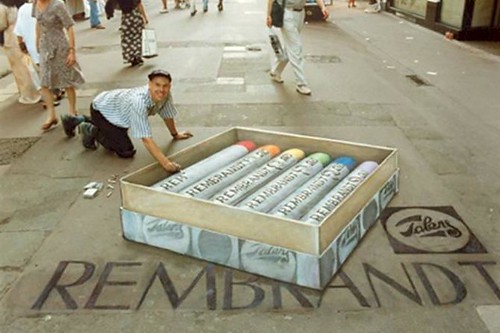
This is completely off topic but mandates a post. If you use Stumble you may have already seen these but they are unbelievable. Below are 3D drawings done with sidewalk chalk by Julian Beever.
I can't help but wonder if he got paid for any product placement on these last two.
Welcome to college. You now must independently maximize utility through rational decision making...aka Whoohoo no parents! As an economics enthusiast, I love trying to comprehend the marginal costs and marginal benefits of everyday life. One major quandary of MCs and MBs students analyze on a daily basis (whether or not they realize it or not) is a timeless center piece of every college experience.
Should I skip class or not?
If attendance is taken daily, you don't really understand the subject matter and there's and exam next week, odds are you should probably go to class.
Sometimes the decision to skip is a no brainer. For instance, last semester I took a class at Geneseo with a professor who will remain nameless, although anyone who goes to Geneseo probably already knows who I'm talking about. The midterm and final exams were each 20 True or False questions based on about 30 pages of reading (anyone with half a brain could easily narrow it down to the ten pages questions would be based on). The only other graded material was written work based on text examples. Not only was attendance not taken, but students were actively encouraged by the professor not to go to class. The first day of class he opened with
"Everyone in this class gets a B. A handful of you will get A's, another handful will get C's, but almost everyone gets a B. In the history of this class nobody has ever failed. I see that all of you have come today, although its a beautiful day so I have no idea why. If I were you I certainly wouldn't be here".
He went on to explain that students didn't need to go to class and that there was no reason to brown nose because he didn't plan on learning anyones names anyway. "If you see me on campus and say hi, I will be happy to wave and say hi back, just be aware I have no idea, nor do I care, who you are."
The reason he didn't care about student attendance or involvement was because in order to complete the writing assignments you had to write them in the text book and hand in the whole book at the end of the year. The catch? He wrote the textbooks which cost about $175 each! The class was essentially a scam where students could buy an easy B for $175. I however still attended a fair amount of classes because this guy has clearly figured out something the rest of us haven't. Not to mention 2/3 of the classes consisted of him telling hilarious stories about his fraternity days at Geneseo.
There are times however where the "to skip or not to skip" dilemma is more of a gray area. So many factors contribute to this momentous, yet sometimes trivial decision. Luckily, fellow college student Jim Filbert has made a true contribution to the academic community, the "Should I Skip Class Calculator". The way the calculator works is you answer about ten questions about the class and it then generates an answer telling you whether or not you should go. The calculator essentially determines the marginal costs of skipping class that day. It takes into account the potential factors that contribute to the overall costs such as:
-How often the class meets -How many weeks of class are in a semester -How many times you have already skipped -Your current standing in the class -When your next major quiz or test is -If you would miss some kind of small daily quiz -Whether or not there is an attendance policy and if so what kind. -How much exam material you would miss by not going -Whether or not important announcements are frequently made in class. -Whether or not you can get important lecture notes/information before next class
Although the calculator does a great job of quantifying marginal costs it doesn't offer any insight regarding marginal benefits. For instance when I used to attend the University of Vermont there would be a lot less kids in class on days when the mountains got a foot of snow or more. On an average day the marginal costs outweighed the marginal benefits, however when it dumped the marginal benefit of an epic powder day outweighed the marginal costs of skipping.
(talk about an awesome marketing campaign)
While surfing the internet I also came across this really cool thing called scanR. ScanR allows students to take pictures of class notes,overheads or whiteboards with a camera phone. It then uploads clean PDF versions of the notes to Facebook so you can share notes with friends. All you need to use it is a camera phone and an account. Here's a video of how it works.
While behavioral and nonmonetary economics (decision making not involving money) can be insightful it doesn't always account for emotional or personal factors. In the book "Freakonomics" the author examines a company that provided bagels to corporate offices. The bagels would be dropped off each morning and a box would be placed next to the bagels with a sign asking employees to pay for however many they took. From a purely monetary/logical standpoint the company shouldn't have made any money. Yet, the amount left in the box at the end of the day was always right on target for what the bagels should have cost. Would stealing a bagel really result in a free bagel? Obviously not since people still paid for them. Apparently stolen bagels are more expensive than free bagels because they have a greater cost, guilt.
Guilt is a major factor of skipping class that neither of the tools mentioned in this post address. Growing up in America, we are instilled with what many refer to as "The Protestant Work Ethic". If you are not being productive, then you are somehow doing something wrong. Often times this leads to unnecessary productivity (if you can really call unnecessary productivity productivity) that is triggered by guilt instead of logic. When most students skip class on some level they feel like they have let somebody down, even if they haven't. I remember once me and a friend were walking to a class we both knew was unnecessary but felt obliged to go to (the same one previously mentioned). When we got there there was a sign on the door saying class was cancelled that day. Walking back, we realized this was the best scenario possible. Even though we weren't going to get anything out of going to class that day we were still relieved of the guilt we would have felt had we skipped without knowing it had been cancelled. Maybe an additional question the "Should I Skip Class Calculator" should ask is "How guilty would you feel about skipping this class?"
Here's a Stephen Colbert interview with conservative strategist Mary Matalin. There is something about this woman that sends chills down my spine. Her "Give a man a fish, teach a man to fish" reference bothers me in so many ways I'm not sure where to start.
First off, Jesus never said that nor is it in the bible. The quote she was trying to incorrectly apply was actually said 400 years before Jesus by Lao Tzu (thanks comment section of video). Second, if that quote was to be used by anyone as manipulative rhetoric it should be liberals. When you say teach a man to fish that implies sacrificing your own resources to help someone else better themselves. I would consider that quote more supportive of better public schools than free market economics. Maybe she should have said "Catch as many fish as you can, sell them, invest in some boats and nets then catch all the fish and under sell your competitors. Now that your fellow fishermen have no lively-hood, pay them the lowest wage possible to catch more fish for you than that wage is worth. Now give somebody a fish so you look charitable."
I was initially excited to hear he was interviewing a well respected conservative strategist. Unfortunately, as Colbert points out, she does a great job of saying absolutely nothing throughout the entire interview. His lead in to the interview says it all "I'll be interviewing conservative strategist...I'll ask her if she came up with "NO"." No seems to be the official stance of the conservative party these days. I've always been more of a free market guy myself but at this point I find myself so alienated by their hysteric rhetoric that supporting them seems laughable.
Last semester the essay question on my final exam for marketing was "How will Tiger Woods' recent scandal affect the Tiger Woods brand?" The answer was that it wouldn't have any significant effect in the long run because the demographic his brand is marketed towards is young men. What that really means is that Bros don't give a shit! Other than doling out a few spontaneous high fives and sexist comments, his core demographic, aka Bros, has remained unaffected, if not encouraged. Despite this, Tiger Woods has still lost a few sponsors that reach beyond the bromographic such as Gatorade and Accenture because "slam pieces" also get thirsty and desire financial stability. CEO of Tag Heuer Jean-Christophe Babin says Tiger's brodultary has actually encouraged them to increase bromotions featuring Tiger Woods. According to Babin
"In China conversely you have Tag Heuer with Tiger Woods everywhere because [with] the Chinese it rather increases their esteem," he said. "In China, by tradition, your success is measured by your number of mistresses."
I hate contributing to meaningless brosteria and wasn't planning on making a post about the scandal but after reading a post on BrosLikeThisSite.com I couldn't resist. The entire post is basically a hilarious explanation of why my essay answer is correct. I highly recommend reading the whole thing These two excerpts pretty much say it all.
"November 27, 2009 bros hit the fucking jackpot. It was on this day that one of our favorite athletes, video games, and Gatorade flavors became so much more. It was on this day that Tiger Woods became the fucking man. As news emerged about the porn stars, reality TV sluts, and waitresses from shitty restaurants that Tiger had banged, bro-haters across the world decided to judge him by spewing brocial slurs such as “sinner,” “sexual deviant,” “liar,” “creep,” or “pervert.” While all these hateful words emerged across the country, there were only two words that came to any true bro’s mind: “Bro. King.” Bros fucking love Tiger Woods."
"Bros have always supported Tiger Woods, but it took a late night Ambien and Vicodin fueled car crash to truly open every bros’ eyes. This weekend as he makes a comeback against all odds with society constantly judging his every move, bro everywhere will be there to support their fallen Bro King. For years, only the Token Black Bro wearing the Nike hat and red shirt on Halloween for the sixth straight year were able to make the claim. But now, thanks to his sacrifice for the rights of his fellow bros everywhere, we are all now able to honestly declare: “I am Tiger Woods.” Your throne awaits, Tiger. Fire away."
I realize I've been pretty lame as far as posting original content goes lately. Once midterms are over I can hopefully have thoughts of my own.
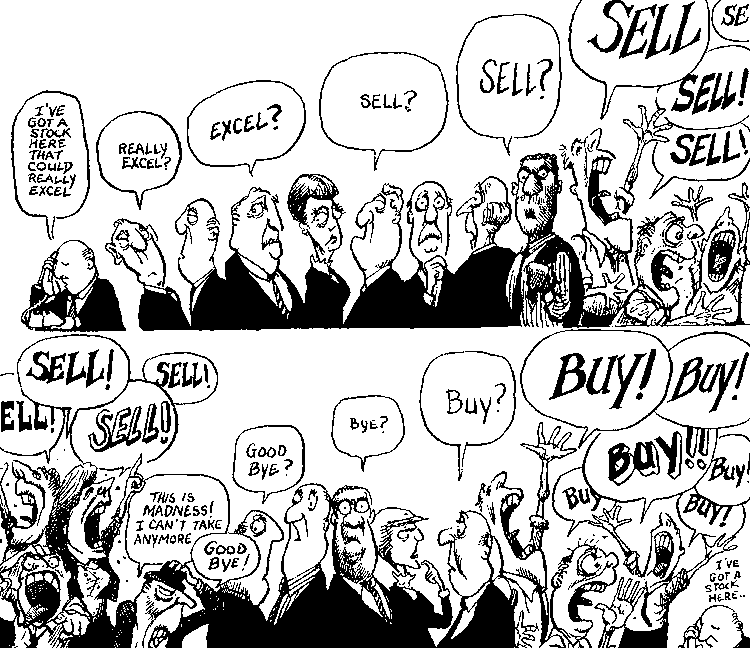
This is one of my favorite political cartoons ever. I saw it in a New Yorker in a waiting a few years ago and it never really left me. The fact that I found it in under 15 seconds on Google is one of those staggering things I know my damn future kids won't appreciate.
The reason I like this so much is because it points out the moral double standard we have for businesses. Everything people do (with maybe a few exceptions) throughout their day is done to maximize their personal benefit. If you are one of the people I know who love to rant about "evil price gouging companies" then take an extra few dollars out of your pay check for no reason.
This is a great unedited interview with Jon Stuart and Bill O'Reilly. Stuart demonstrates his true brilliance as he walks the tight rope that is an O'Reilly interview. Throughout the interview O'Reilly tries to trap Jon Stuart by making sweeping generalizations and cutting down straw men while Stuart tactfully avoids them all while making excellent points and still being hilarious (although only one person somewhere on the set was actually laughing at his jokes).
I remember when I used to watch Bill O'Reilly with my mom and would marvel at how they could let someone like him on television. Now, as the interview points out, Bill O'Reilly is one of the more boring, middle of the road guys on Fox. He actually graduated from my high school and came to speak at career day. You wouldn't think it possible but he is a way bigger asshole in person. During his speech he managed to shoot down both women and the underclass before answering pre-screened questions from students (the year before some kid asked him about his sex scandal and it did not go well).
I'm not sure who wrote this but I stole it off Jake's Facebook feed, interesting point.
This morning I was awoken by my alarm clock powered by electricity generated by the public power monopoly regulated by the US department of energy. I took a shower in the clean water provided by the municipal water utility. After that, I turned on the TV to one of the FCC regulated channels to see what the national weather service of the national oceanographic and atmospheric administration determined the weather was going to be like using satellites designed, built, and launched by the national aeronautics and space administration. I watched this while eating my breakfast of US department of agriculture inspected food and taking the drugs which have been determined as safe by the food and drug administration.
At the appropriate time as regulated by the US congress and kept accurate by the national institute of standards and technology and the US naval observatory, I get into my national highway traffic safety administration approved automobile and set out to work on the roads built by local, state, and federal departments of transportation., possibly stopping to purchase additional fuel of a quality level determined by the environmental protection agency, using legal tender issued by the federal reserve bank. On the way out the door I deposit any mail I have to be sound out via the US postal service and drop the kids off at the public school. After work, I drive my NHTSA car back home on the DOT roads, to a house which has not burned down in my absence because of the state and local building codes and fire marshal’s inspection, and which has not been plundered of all it’s valuables thanks to the local police department.
I then log onto the internet which was developed by the defense advanced research projects administration and post on freepublic.com and fox news forums about how SOCIALISM in medicine is BAD because the government can’t do anything right.
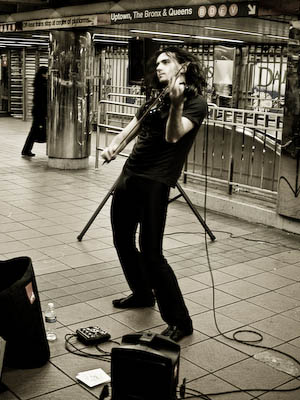
I was walking through Penn Station yesterday and came across this guy who's name is apparently Michael Shulman. At first I just thought he was a crazy street performer. He was drawing a huge crowd so I took a closer look and realized he is, well, a crazy street performer but an incredibly talented one none the less. He was absolutely shredding this electric violin while playing samples and dancing as well as playing some covers of everything from Britney Spears to Michael Jackson. He would put his violin riffs on loop and they play on top of them. The crowd was going crazy for him. More Michael Shulman by md9
It turns out he has a website and everything. His bio is unbelievable. He came here from Russia when he was 17 without knowing one person here or a word of English. He also doesn't practice songs and just improvs everything he does. I bought a CD from him an uploaded the tracks.
Enough is enough, it is time to free the grapes. As I mentioned in The Long Tail, Making Your Life Awesome Since 2004 we are shifting away from an economy of high sales of a few items to low sales of LOTS of items. Everywhere you look choices are becoming more numerous and products increasingly customized. However, if you happen to be a wine lover in Pennsylvania, Maryland, Delaware, Indiana, Kentucky,Tennessee,Alabama, Mississippi, Arkansas, Oklahoma, Utah, Montana or South Dakota I'm afraid you are out of luck. There, state law prohibits direct shipping of alcohol, meaning if you are a wine drinker in one of these states you must do something unthinkable to most Americans, get it yourself! Still, the real issue here isn't so much that you have to haul yourself down to Bottle Buy but the severe limitations that puts on your freedom of selection. Going to a store means having to pick from only the wines they offer as opposed to EVERY WINE AVAILABLE ON THE INTERNET.
The nature of enjoying wine makes these laws particularly disenfranchising. When it comes to drinking wine each individual has a myriad of their own specific likes and dislikes. The extensive information and selection offered online lets you find wines that you personally will enjoy instead of rolling the dice with the suggestion of the shaggy 19 year old behind the counter of your local liquor store. Internet wine companies also help support small businesses that lack the necessary brand recognition or access to distribution channels to get their quality wines to the people who would enjoy them. My Wines Direct for example screens thousands of wines from small vineyards all over the world to come up with savory gems for your enjoyment. Free The Grapes! is a national, grassroots coalition of consumers, wineries and retailers who seek to remove restrictions on wine direct shipping. Maryland and New Jersey are two particular battlegrounds that are on the fence. While politicians and economists scramble to find remedies to this recession, they fail to realize there are economic impediments right under their noses that benefit no one. If you would like to help overturn such laws check out the Free the Grapes! website. Until then, Pennsylvania wine lovers, maybe you can talk your New York neighbors into trading for some fireworks.
I've been thinking a lot lately about the philosophical Jacob Black to Milton Friedman's Edward Cullen (Twilight reference, and yes, I saw it), Karl Marx. I am always frustrated by people who write off Karl Marx with the faint hearted logic that since communism "failed" he has no insight to offer. Worse are those who dismiss him based purely on the negative connotations of his name in the context of our capitalist society. I think some of Marx' ideas have particularly relevant applications to our world today especially as we are seeing a rapid increase in the exploitation of the lower class by the upper class.
Before you get all excited and start throwing around words that start with "S" and "C"(no, not shit or cunt, those words are far more acceptable in America)I would like to point out that I am not a man of distinct political or ideological orientation so much as one who simply enjoys the intellectual exercise of looking at ideas form different perspectives.
Karl Marx wore a lot of hats; philosopher, sociologist, revolutionary, economist..etc. but as of late I have found his sociological insights particularly interesting.
According to Marx there are two groups in the capitalist system, the capitalists (upper class) and the proletariat (lower class). The capitalists have the majority of the wealth and therefore possess the majority of the influence. They use this influence to maintain their dominance over the proletariat. Two important factors that allow this occur are the relationship between the capitalists and the state and the relationship between the capitalists and the proletariat. According to Marx it is the primary function of the state to promote the interests of the capitalists. Since the capitalists control the wealth they can influence the state to act on their behalf. As for the relationship between the capitalists and the proletariat, the capitalists extract their wealth from the proletariat through what is called surplus value extraction (explained later). The most important part of this relationship is that the proletariat are unaware of the nature of their relationship to the capitalists. The state has no real interest in the well being of the proletariat because the proletariat has nothing to offer or persuade them with.
Now lets see how this compares with the present day...
In recent years the stratification between the rich and poor has grown at a devastating pace. In 1980, on average, CEOs at 365 of the largest publicly traded U.S. companies earned 42 times more than their average worker. By 1990 the ratio had increased to 85. Thats nothing compared to 2000 when the same CEOs made 531 times more than their average worker. I know what you Friedman(or Glen Beck for those who prefer patriotism over reading)fans out there are thinking. "The reason they make so much is because they are the most skilled and therefore require higher pay". I wouldn't argue against this for a second if the level of compensation was an accurate reflection of ability. According to advocacy group UFE, U.S. CEOs pay rose 313% from 1990 to 2003 while corporate profits gained only 128%. Its hard to argue that we don't have severe class stratification when the top 10% wealthiest Americans control 90% of the wealth.
The relationship between the capitalists and the state is always the one I find most personally upsetting. Almost every aspect of government in the U.S. is heavily influenced by its corresponding corporate sector. In my post Normal Food I talked about how judges and higher ups of the FDA have "close" relationships with major food producing corporations such as Supreme Court Justice Clarence Thomas previously heading up the legal team of Montesano. Even more disturbing is that FDA Deputy Commissioner on Policy Michael Taylor represented Montesano in the lawsuit over whether they should have to label genetically modified food (they won). On the international level the U.S. government forces third wold countries trapped in debt to sign massive contracts with U.S. corporations such as Haliburton (sound familiar?) and Bethel. These countries are also forced into privatizing government assets which extracts common wealth from the native people and sends it back to those corporations (ex people of Ecuador losing their oil reserves to Texcao).
The relationship between the Capitalists and Proletariat is subtle yet at the same time paraded around for all to see. In Marx' theory he talks about surplus value extraction. Surplus value extraction in a nutshell: Value is created through labor...workers create a certain amount of value throughout the day...instead of keeping the value they create they are given a small fraction of that in their wage...the capitalist extracts that surplus value that worker just created in exchange for a low wage and keeps the majority of the value. The most curios part of this relationship is the Proletariat's lack of awareness of the relationship. After a long hard day working for a proportionately miniscule wage what does the worker do with it? Gives that money right back to the capitalists. Its amazing in todays society how enamored we have become with material goods. This frenzied consumerism has stemmed from corporate demand for growth. In America we live in a fully saturated market. Everyone (except those who can't afford it) has everything they need. Therefore the only way for corporations to grow is to create wants so we can continue spending. The point of Walmart is that since everything costs less you can get more stuff. Their official slogan is "Save Money, Live Better". Nobody can deny that when you walk out of Walmart after finding an incredibly great deal you feel like you have somehow won. You have more "stuff" and you got it at Walmarts expense. In reality you have siphoned money out of your community and sent it back to Walmart headquarters so you can enjoy the cheap thrill of a short term gain at the expense of your community in the long run.
I realize all these points beg deeper explanation but I'm also aware that nobody wants to read a ten page paper (or maybe even brief blog post) about the modern applications of Karl Marx.
One of my favorite (and true) anecdotes regarding capitalists: In his last dying days Andrew Carnegie sought rapprochement with his former business partner Henry Clay Flick. Upon being asked to make up Frick responded "Carnegie, we are both going to hell and I will see you there!"
"I don't think I should get a job I don't deserve over a white man, but if its tie...fuck em." Chris Rock
First I'd like to thank all you high school and college students for breaking the mold. The link I posted on Facebook with the caption "post about marijuana" led to The Business Behind Getting High being the most popular post yet.
This pretty much says it all
Right now I'm writing a paper for my business ethics class on affirmative action. I'm supposed to determine whether it is morally right in certain situations for a company to set a quota for how many minorities they hire. At first glance this sounds outrageously immoral but upon logically analyzing the situation it seems to make perfect sense in some cases, specifically in those pertaining to larger societal discriminations that limit the opportunity for minorities to educate themselves to the point where they can join the skilled labor force. I've always believed in reparations but writing a check to the disadvantaged doesn't do anything to correct the broken system in place. Instead I think reparations should be provided through educational opportunities where people have an actual chance to better themselves. At this point I am putting off this paper so fervently that I've resorted to still writing about affirmative action but in a different medium. I realize people hate engaging in almost any internet activity that doesn't increase their immediate social capital but I'd love to hear people's opinions on this. If you don't know what I mean by social capital read my post The Whopper Sacrifice
I just finished watching a documentary about marijuana called "The Union: The Business Behind Getting High" and I thought it was excellent. It raised too many interesting points for me to cover in one blog post so I figured I would just put up the video itself. Let's be honest, you aren't doing anything important right now anyway.
According to them the 12 biggest ripoffs in America are as follows
Movie Theater Popcorn Text Messages College Text Books Brand Painkillers "Free" Credit Reports Wine Service at Restaurants Hotel Mini-Bars All You Can Eat Buffets Premium Gasoline Actively Managed Investments In-Room Movies Health Club Memberships Ink Cartridges
I'll admit that in typical honky fashion I misunderstood the words to this song the first time I heard it on the radio. Instead of saying "bag" I initially thought he was saying "bank", which made sense to me since he starts by saying "I got that black amex aka that throw it in the bag (or bank) card". Although I now know the real lyrics I still enjoy listening to the song while assuming he is instead saying "bank" and talking about shamelessly acquiring copious amounts of credit card debt (give it a try). In this assumption of mine, Fabulous understands that he has no choice but to maintain a certain standard of living in the present regardless of what that equates to in the future. It doesn't matter that he is making disastrous long run decisions because HAS TO remain fly in the present.
Like most Americans, this song always makes me think about bank bailouts and where all those toxic assets really went. Everyone would agree that the recession we are theoretically coming out of has been an uncomfortable burden to bare but shouldn't it have been a lot worse? We aren't just talking about the dot-com bubble bursting or a housing market slump but the collapse of our entire banking system. As aggravated as all the populist rhetoric about bank bailouts is, they are what has allowed us to maintain this relatively stable, comfortable standard of living. Although we averted disaster via the government buying up bank's toxic assets that doesn't mean the problem just went away. It's not like there was some massive surplus in a glass case labeled "IN CASE OF RECESSION BREAK GLASS". So where did those toxic assets go? They got added on to the already enormous US debt, debt that we as a country have to pay interest on. Instead of dealing with the real recession we were supposed to face we have essentially thrown it on a credit card (call it China Express) to maintain the standard of living that has become ABSOLUTELY NECESSARY to America. Saying some banks are too big to fail is like saying Fabulous is too famous to be broke. I personally do not know enough to argue whether or not we should have bailed out the banks. However, I can say that I'm happy to be blogging on my laptop at college instead of standing on a bread line on Long Island.
Although those were all assumptions that I was making about Fabulous I can't help but suspect he needed to make some extra money on the side. Case and point, when I googled his name to find a picture for this post I discovered he was recently arrested for having 500lbs of marijuana on his tour bus en route from the NBA All Star Game in Phoenix to Boston where he claims to have been going to "pick up someone who's name he could not remember". I told myself I wasn't going to make a bailout joke here and I'm sticking to that.